


FAIRNESS IN ELECTIONS
“The times, places and manner of holding elections for Senators and Representatives, shall be prescribed in each state by the legislature thereof; but the Congress may at any time by law make or alter such regulations.”
Founder Samuel Adams recognized the sacred value of a citizen voted when he stated in 1781, “Let each citizen remember at the moment he is offering his vote … that he is executing one of the most solemn trusts in human society for which he is accountable to God and his country.”
The Elections Clause of the Constitutional provides authority to Congress for setting the date of national elections, but cedes all authority for procedures and protocols to hold those elections to state legislatures. As such, states have the constitutional authority to ensure the fairness of elections through laws that protect the sacred vote of each individual voter.
There was a time in America where keeping a ballot safe and secure while demanding every voter provide confirmation of their identity was considered sacrosanct and widely accepted as an important protection of our democracy.
For several decades, liberals have initiated an ongoing assault of the fairness of elections. They do so in three primary ways: 1. fostering the false narrative that presenting identification to vote is “discrimination”; 2. encouraging liberal state legislators to pass laws that lessen ballot protections; and 3. finding progressive judges willing to step out of their lawful constitutional authority and make changes to codified election protocols.
ACRU has been at the forefront of election integrity work for over a decade. From suing Broward County, Florida and other counties to clean up their voter rolls to prevent fraud, to advocating for protections for seniors and military, ACRU has been a leader. Prior to the 2020 elections, ACRU worked to defend the integrity of votes of two vulnerable and at-risk voting populations — the nation’s senior citizens and our military—through our very active Protect Elderly Votes (www.protectelderlyvotes.org)and Protect Military Votes (www.protectmilitaryvotes.org) initiatives.
As 2021 dawned, a new threat has emerged to election integrity — the cynically named “For the People Act,” or H.R. 1. This federal legislation steals every aspect of state control over election procedures from our states. As one of its first 2021 projects, ACRU created a Fact Sheet about of H.R. 1 to educate the public on this legislation —which rattles the very cornerstone of our liberty.
American Constitution Rights Union will continue to fearlessly defend election fairness, vote integrity, and is willing to take on liberal legislators and media and “cancel culture” to ensure that the vote of every legal voter is counted and protected.
Support the ACRU by making a donation today!
Citation: https://www.law.cornell.edu/constitution-conan/article-1/section-4/clause-1

ACRU ELECTION INTEGRITY INITIATIVES


We Must Protect Vulnerable Voters
Election Issues
Protecting the Voting Rights and Autonomy of Vulnerable Residents in Long-Term Care Facilities
CMS has issued updated guidance reminding nursing homes and skilled nursing facilities that residents have the right to vote, or to decline to vote, without interference, coercion, discrimination, or reprisal. The memo also warns facilities to comply with federal and state election laws and encourages the use of bipartisan election workers where state law allows.
It Just Got Harder for Ballot Harvesters to Dupe Nursing Home Residents
If grandma voted for the first time after she stopped recognizing her own children, it might be voter fraud. The Centers for Medicare and Medicaid Services (CMS) has sent a letter to nursing homes rescinding a Biden-era directive that made it easy to harvest ballots among vulnerable residents.
ACRU Files Amicus Brief Defending the Attorney General’s 60-Year-Old Power to Inspect Voter Records
ACRU has filed a "friend of the court" brief in the Sixth Circuit Court of Appeals, backing the Department of Justice's request that the full court rehear a case with real consequences for federal election oversight.
Mobile woman indicted for election fraud — DA: Suspect tried to receive absentee ballot for ‘incapacitated victim’
Michele Toomey has been indicted for allegedly committing election fraud in Mobile County. Toomey is charged with two felonies and a misdemeanor for voter harvesting, identity theft and forgery.
Family catches unauthorized voting change at Owasso nursing home for dementia patient
A man with dementia at an Owasso nursing home allegedly had his voting party changed by staff without permission from his guardians.
ACRU ELECTION INTEGRITY PARTNERS
Ranked Choice Voting Fact Sheet

Learn More About Ranked Choice Voting Dangers at StopRCV

ACRU ELECTION INTEGRITY COMMENTARY
Protecting the Voting Rights and Autonomy of Vulnerable Residents in Long-Term Care Facilities
CMS has issued updated guidance reminding nursing homes and skilled nursing facilities that residents have the right to vote, or to decline to vote, without interference, coercion, discrimination, or reprisal. The memo also warns facilities to comply with federal and state election laws and encourages the use of bipartisan election workers where state law allows.
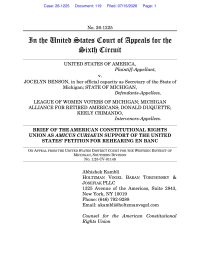
ACRU Files Amicus Brief Defending the Attorney General’s 60-Year-Old Power to Inspect Voter Records
ACRU has filed a "friend of the court" brief in the Sixth Circuit Court of Appeals, backing the Department of Justice's request that the full court rehear a case with real consequences for federal election oversight.

Mobile woman indicted for election fraud — DA: Suspect tried to receive absentee ballot for ‘incapacitated victim’
Michele Toomey has been indicted for allegedly committing election fraud in Mobile County. Toomey is charged with two felonies and a misdemeanor for voter harvesting, identity theft and forgery.
Family catches unauthorized voting change at Owasso nursing home for dementia patient
A man with dementia at an Owasso nursing home allegedly had his voting party changed by staff without permission from his guardians.

15 Arrests and the Fraud They Said Didn’t Exist
Fifteen Texas officials, including a county judge, city council members, and a former San Antonio mayoral candidate, have been indicted in one of the largest vote harvesting cases in recent state history. The Frio County indictments prove that organized election fraud is real, and that it targets the voters least equipped to fight back.
The Six-Year Shelf Life of a Constitutional Principle
Democrats championed nonpartisan redistricting in Virginia. Now they want to scrap it and redraw the maps 10-1 in their favor. Constitutional principles, it turns out, have expiration dates.

Reject the Radical, Risky National Popular Vote Compact
A campaign that started in California in 2006 has reached Richmond, and it's gunning for the Electoral College. Bills passed by Virginia's House and Senate would add the Commonwealth to the National Popular Vote Interstate Compact, a scheme that would force Virginia to ignore its own voters and hand its presidential electors to whoever wins a nationwide popularity contest. There's no official national vote total, it likely violates the Constitution's Compact Clause, and every single state that's signed on is blue. Here's why Gov. Spanberger should reject it.
Election Day Means Election Day
The U.S. Supreme Court is set to hear Watson v. Republican National Committee, a case that could redefine what “Election Day” means nationwide. At stake is whether ballots must be received by Election Day or may arrive afterward — a decision with major implications for election law, voter confidence, and the uniformity of federal elections.

ACRU Files Amicus Brief in Watson v. Republican National Committee
The American Constitutional Rights Union has filed an amicus curiae brief with the United States Supreme Court in Watson v. Republican National Committee (No. 24-1260), joining the Public Interest Legal Foundation in support of the Respondents.The case centers on a straightforward but consequential question: does federal law require that ballots be received by Election Day? The Mississippi Secretary of State argues states can extend ballot receipt deadlines beyond Election Day. The Respondents, and ACRU, say no.

One Thing Leads to Another
The basic purpose of the SAVE Act is to require individuals to provide documentary proof of U.S. citizenship when registering to vote in federal elections. Now, this sounds just simple, easily comprehensible, and agreeable, right?